FTC Disclosure: LimeCrema is a participant in the Amazon Services LLC Associates Program, and we have an affiliate partnership with TappWater. When you buy through links on our site we may earn a commission at no extra cost to you. Learn more.
Your espresso machine has a problem it never tells you about: every litre of water that passes through it leaves a little calcium behind. Over months, that scale coats the boiler, narrows the flow and quietly shortens the machine's life. The fix is unglamorous and cheap – a water filter matched to your machine. This guide explains the difference between in-tank and inline filters, then picks the right cartridge for Breville, De'Longhi, Philips/Saeco, Jura and Gaggia, plus the inline BWT option for plumbed machines. Every price and rating was verified on Amazon.com in October 2026.
If you are still deciding what water to use, start with best water for espresso machines. To clean a machine that has already scaled up, see how to descale an espresso machine.
| Filter | Fits / Best for | Price | Link |
|---|---|---|---|
| Breville BES008 (ClaroSwiss) | Breville – Best overall | $16.95 | Check Price |
| De'Longhi Water Filter DLSC002 | De'Longhi – Best value | $11.99 | Check Price |
| Philips AquaClean CA6903/22 | Philips & Saeco | $28.24 | Check Price |
| Jura Claris Smart+ 24232 | Jura super-automatics | $23.10 | Check Price |
| Gaggia Brita Intenza+ (2-Pack) | Gaggia & Italian brands | $24.95 | Check Price |
| Breville BWF100 (6-Pack) | Older Breville – refill value | $26.95 | Check Price |
| BWT Bestmax S Premium | Plumbed/under-counter – Pro | $110.84 | Check Price |
Why an Espresso Machine Needs a Water Filter
Two problems, one solution. The first is taste: chlorine and other tap-water compounds show up in the cup, and unbalanced mineral content makes extraction uneven – hard water reads bitter and chalky, soft water reads flat. The second, bigger problem is scale: when water is heated, dissolved calcium and bicarbonate can deposit as limescale inside the boiler and narrow passages. Scale is the leading cause of slow shots, temperature instability and premature machine failure.
An espresso filter attacks both. Most in-tank cartridges combine activated carbon (for chlorine and taste) with ion-exchange resin (to reduce hardness), while inline cartridges like BWT's carry much more resin and also often add minerals back. The result is water closer to the SCA's target window – roughly 150 ppm TDS, ~68 ppm hardness, ~40 ppm alkalinity, no chlorine – which is both better-tasting and gentler on the machine.
In-Tank vs Inline vs Under-Sink
In-tank filters
A small cartridge that sits in the reservoir. No plumbing, cheap, and most machines have a dedicated slot plus a change indicator. Examples: Breville ClaroSwiss, De'Longhi DLSC002, Philips AquaClean, Jura Claris. Downside: limited resin, so you replace it every ~2 months, and it only treats the water you put in the tank.
Inline filters
Plumbed into the machine's water line behind or under the counter – usually a BWT Bestmax head unit with a screw-in cartridge. Far more capacity (rated in litres), better for hard water and for plumbed machines that brew often. Downside: installation and a higher up-front cost.
Under-sink / whole-home
A carbon or RO system that treats water before it reaches the machine (and your tap). Best when you also want cleaner drinking water; a countertop example is covered in our TappWater review, and under-sink options in the water guide. If your concern is contaminants such as PFAS, see PFAS in drinking water.
The 7 Best Espresso Machine Water Filters
Breville BES008 Water Filter (ClaroSwiss) — Best for Breville
Best Overall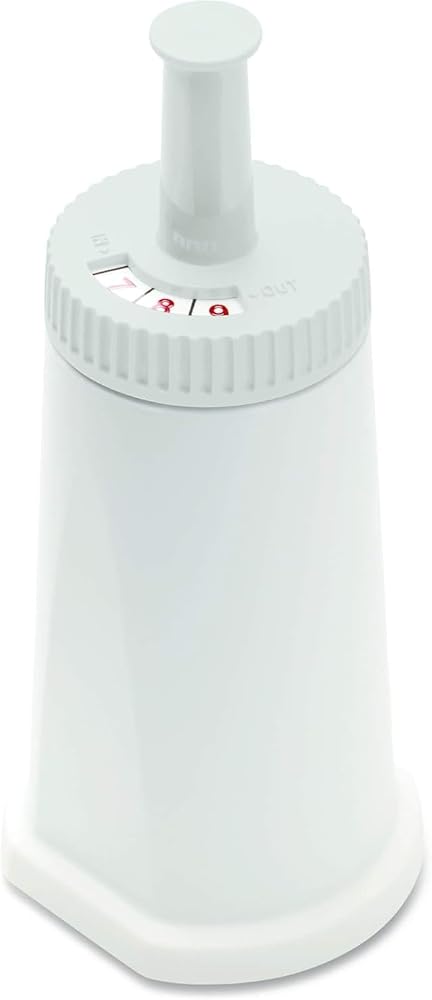
★ 4.8/5 from 878 verified Amazon reviews. If you own a current Breville – Barista Touch, Barista Pro, Oracle, Dual Boiler or Bambino ClaroSwiss – this is the correct cartridge, and Breville's own system is well-regarded for a reason: it is specified for the machine, so fit and flow are right and there is no warranty question. It sits in the tank and reduces the hardness and chlorine that cause scale and dull taste. Buy the brand cartridge and you are following the manufacturer's spec; the only downside is the two-month-ish replacement rhythm. (For older Breville models that take the cylindrical charcoal cartridge, see the BWF100 entry below.)
- Pros
- Correct, model-specific fit for current Breville machines
- 4.8★ from 878 reviews
- Carbon + resin – taste and hardness
- No warranty ambiguity
- Cons
- Breville-specific – will not fit other brands
- ~2-month replacement cycle
- Pricier than generic knock-offs
De'Longhi Water Filter (DLSC002) — Best Value
Best Value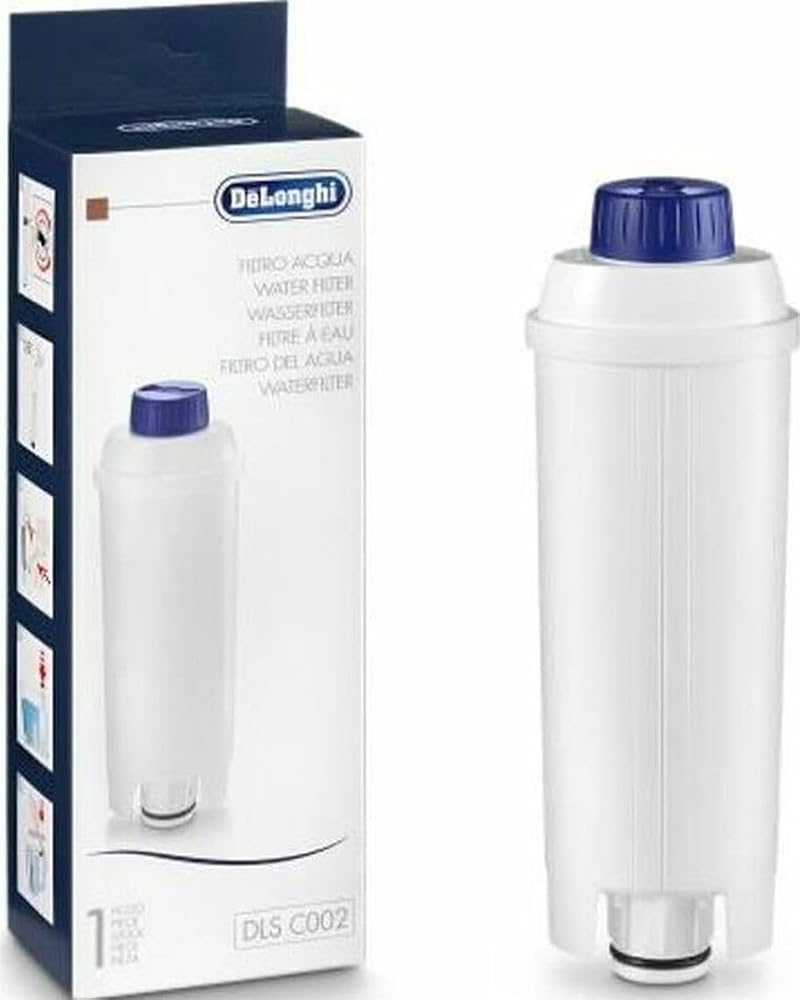
★ 4.8/5 from 54,353 verified Amazon reviews. The most-reviewed espresso water filter on Amazon, and the cheapest per cartridge on this list. It is De'Longhi's standard in-tank filter, used across the Dinamica, Magnifica, Eletta and Dedica families, and it softens and dechlorinates the water in the tank. At $11.99 it removes the last excuse not to filter a De'Longhi. Note that availability and pricing can vary and De'Longhi lists several compatible part numbers – confirm yours against the manual before buying.
- Pros
- Cheapest per cartridge here ($11.99)
- 54,000+ reviews at 4.8★
- Fits the De'Longhi range (Dinamica/Magnifica/Eletta/Dedica)
- Genuine part
- Cons
- De'Longhi-specific
- Replace every ~2 months
- Several part numbers – check yours
Philips AquaClean CA6903/22 — Best for Philips & Saeco
Best Philips/Saeco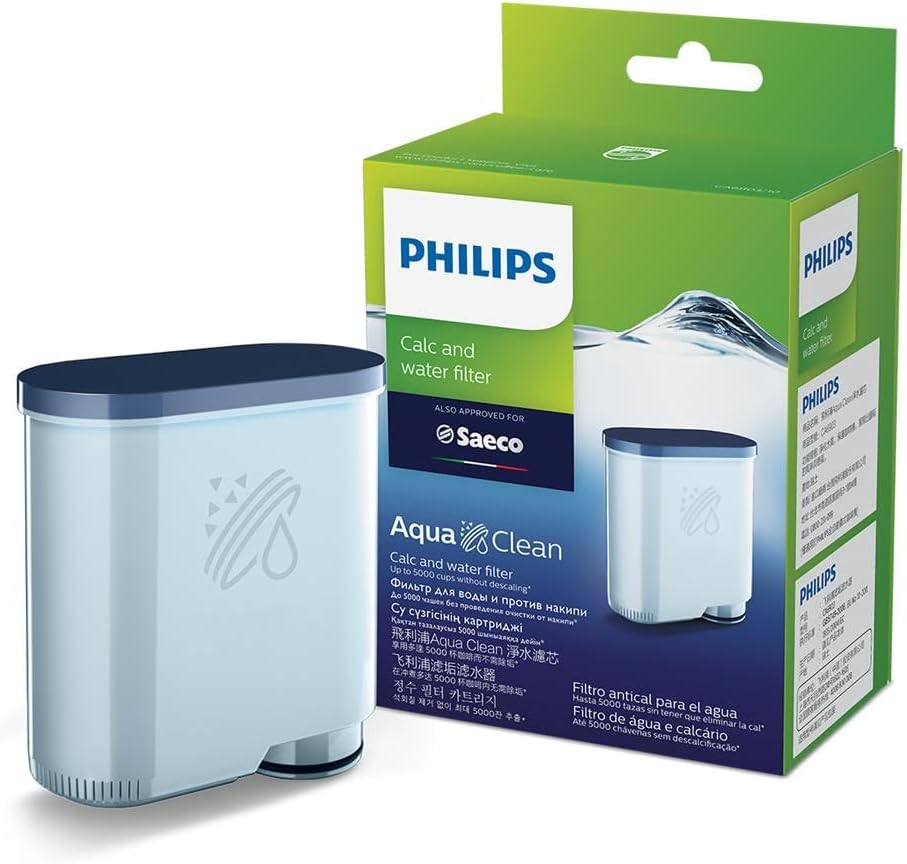
★ 4.8/5 from 6,214 verified Amazon reviews. AquaClean is Philips' answer to hard water in its LatteGo and Saeco lines, and it is a strong one – the manufacturer claims it can extend intervals between descaling to up to 5,000 cups. This listing is the CA6903/22, a two-filter pack that fits the current Philips and Saeco super-automatics. As always, the "no descaling" figure is the manufacturer's claim rather than our test, and it still assumes you replace the filter on schedule – a spent cartridge protects nothing.
- Pros
- Specified for Philips & Saeco machines
- 4.8★ from 6,214 reviews
- Long service claim (up to 5,000 cups – manufacturer)
- Two filters per box
- Cons
- Manufacturer claim, not independently verified by us
- Higher price per filter
- Philips/Saeco-specific
Jura Claris Smart+ Water Filter (24232)
Best for Jura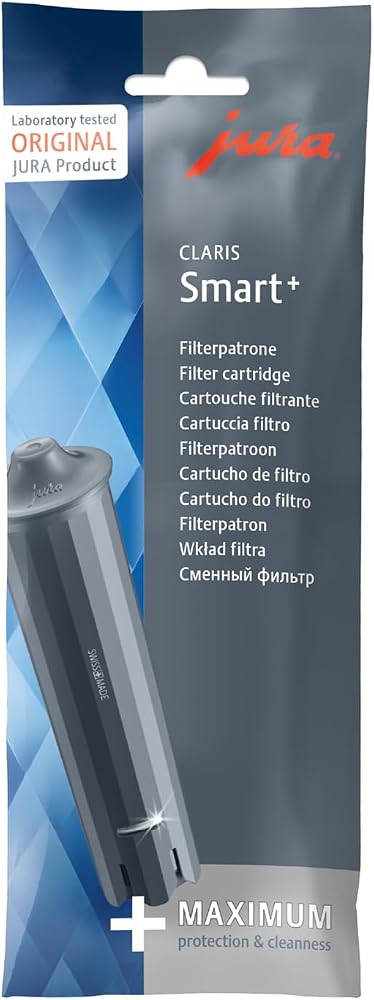
★ 4.7/5 from 2,026 verified Amazon reviews. If you run a Jura (E4, E6, ENA, S or WE line), Claris Smart+ is the cartridge the machine is designed around – the "Smart" version carries an RFID tag that lets the Jura adjust its own descaling schedule to the filter. That automatic integration is genuinely useful and hard to replicate with a cheaper generic. The trade-off is cost per cartridge and the fact that it is strictly a Jura part. Pair it with the same maintenance mindset as any Jura owner: filter on schedule, descale when the machine says so.
- Pros
- Machine reads the filter and sets the descale schedule
- 4.7★ from 2,026 reviews
- Genuine Jura Claris Smart+ (24232)
- Fits the Jura super-automatic range
- Cons
- Jura-specific
- Higher cost per cartridge
- Only worth it on a genuine Jura machine
Brita Intenza+ Water Filter for Gaggia Espresso Machines (2-Pack)
Best for Gaggia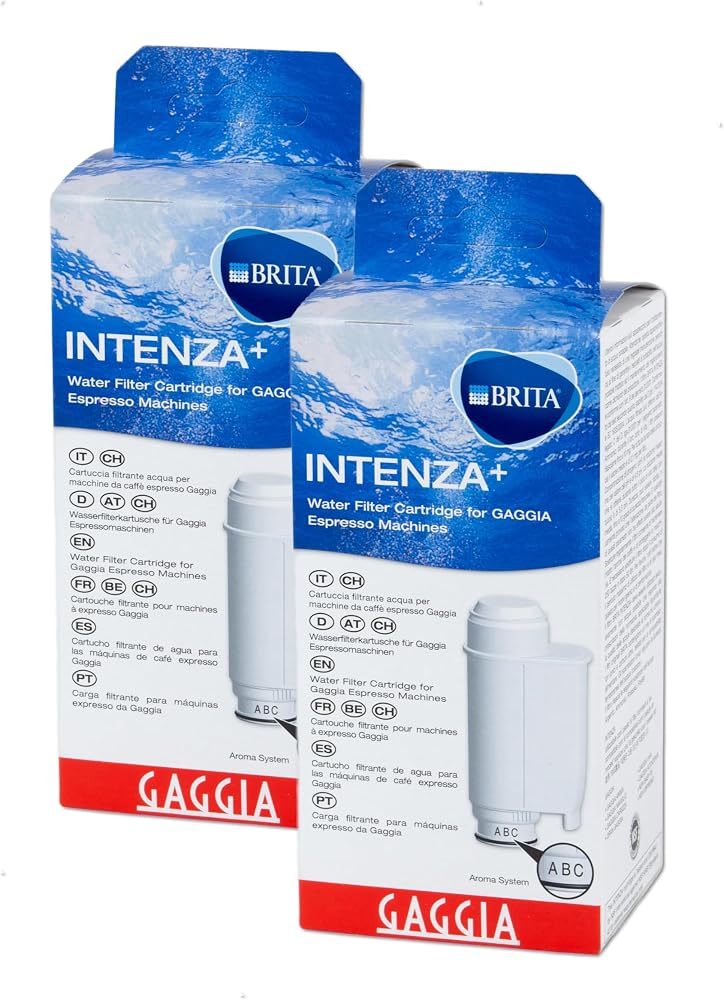
★ 4.7/5 from 598 verified Amazon reviews. Gaggia (and many other Italian machines – Ascaso, Lelit, Quickmill and more) use the Brita Intenza+ cartridge, and this two-pack is the straightforward refill. Brita's Intenza+ is a resin-and-carbon cartridge designed to reduce hardness and chlorine, which is exactly what a Gaggia Classic, Evo Pro or Gaggia super-automatic wants before the water hits the boiler. Confirm the fit against your machine's manual, as some older Gaggia models use a different cartridge.
- Pros
- Standard cartridge for Gaggia and many Italian machines
- 4.7★ from 598 reviews
- Two cartridges per pack
- Brita's proven Intenza+ resin + carbon
- Cons
- Not universal – check your model
- Lower review count than the big-brand filters
- Two-month-ish replacement cycle
Breville BWF100 Charcoal Replacement Water Filters (6-Pack)
Best Refill Value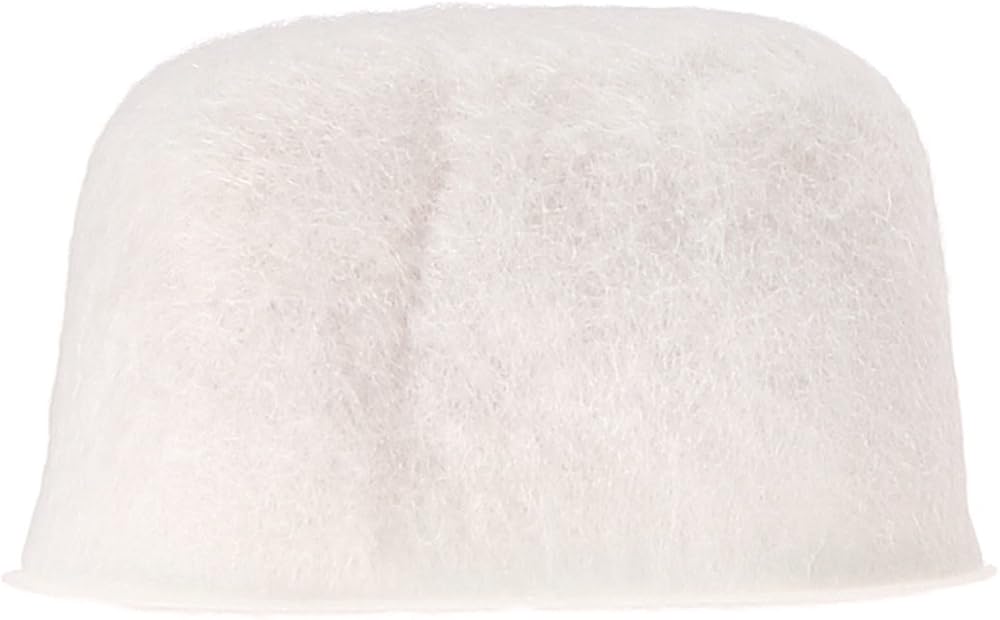
★ 4.7/5 from 5,694 verified Amazon reviews. The BWF100 is the cylindrical charcoal cartridge used by older Breville machines (the BES8xx/BKC series and similar) – the predecessor to ClaroSwiss. This six-pack works out far cheaper per filter than buying singles, which suits the fact that these are two-month consumables. It is a charcoal filter, so read it as taste-and-chlorine plus some sediment; if you specifically need hardness reduction, the newer ClaroSwiss BES008 is the better match. Check which style your Breville takes before ordering.
- Pros
- Six filters – low cost per cartridge
- 4.7★ from 5,694 reviews
- Genuine Breville part for older models
- Easy drop-in fit
- Cons
- Charcoal only – limited hardness reduction
- For older Breville models, not current ClaroSwiss machines
- Still a two-month consumable
BWT Bestmax S Premium Inline Water Filter for Espresso Machines
Best for Hard Water & Plumbed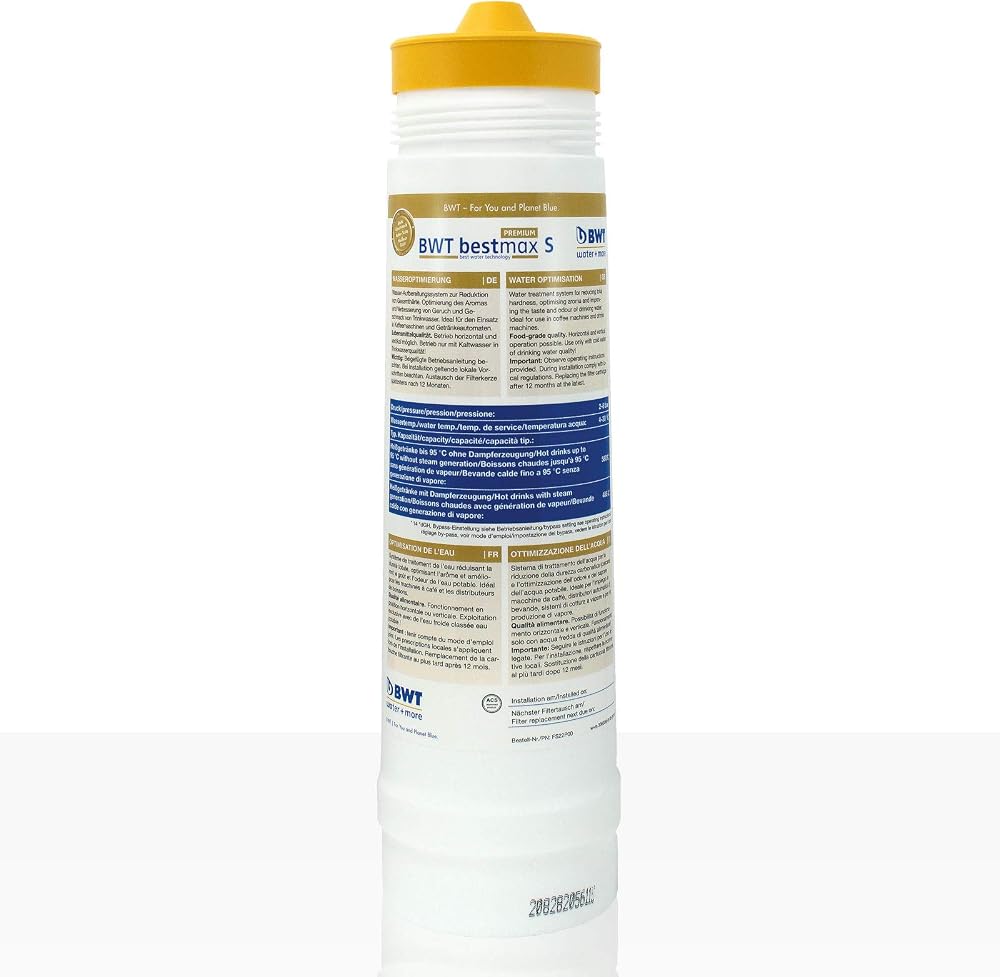
★ 4.5/5 from 153 verified Amazon reviews. This is the pro answer. BWT's Bestmax is an inline cartridge that mounts in a head unit on the water line, and because it holds far more resin than any in-tank filter it lasts far longer – the "S" size is rated for a four-figure litres capacity depending on your water hardness. It is 5-stage filtration aimed squarely at espresso machines and hard water, and it is the filter you fit when the machine is plumbed in and you are tired of changing tiny cartridges. The trade-offs are the $110 up-front cost, installation, and the small review base. For a home machine in a very hard-water area, it is often worth it.
- Pros
- Far greater capacity than in-tank filters
- Built for espresso and hard water
- Ideal for plumbed machines
- 5-stage filtration (manufacturer spec)
- Cons
- $110.84 up front, plus head unit
- Requires plumbing/installation
- Small review base (153) for a big purchase
How to Choose the Right Filter
Match the part number to your machine
Filters are not universal. Find your model in the manual's "accessories" or "consumables" section and buy that part number: Breville ClaroSwiss BES008 (or BWF100 for older models), De'Longhi DLSC002, Philips/Saeco AquaClean CA6903, Jura Claris Smart+ 24232, Gaggia Brita Intenza+. A generic "fits many machines" cartridge is a gamble on both fit and resin quality.
Match the filter type to your water
Lightly hard water and a super-automatic → an in-tank resin cartridge is usually enough. Very hard water, or a plumbed-in machine → go inline (BWT Bestmax) for capacity. If you mainly want chlorine removal for taste, even a good pitcher helps; for the full picture see best water for espresso machines.
Budget the replacements
Every filter on this page is a consumable. In-tank cartridges run about every two months; the inline BWT runs in litres. Price the refills, not just the box, and set a reminder – a filter left in too long stops softening the water while still looking perfectly fine.
FAQ
Do espresso machines really need a water filter?
If your water is anything above moderately hard, yes. An in-tank filter is the cheapest insurance you can buy for a machine: it reduces the calcium and other minerals that form limescale in the boiler, which is the most common cause of slow shots, temperature drift and premature failure. Filters also remove chlorine and off-flavours. If your water is already soft, a filter is less critical, but it still helps with taste and consistency – so measure your water first.
What is the difference between an in-tank filter and an inline filter?
An in-tank filter sits inside the water reservoir – a small cartridge you drop into the tank, like Breville ClaroSwiss, De'Longhi DLSC002 or Philips AquaClean. An inline filter is plumbed into the water line behind or under the machine (often a BWT Bestmax cartridge in a head unit). In-tank is simple and needs no plumbing; inline holds much more resin, lasts longer and is the usual choice for high-volume or plumbed-in machines in hard-water areas.
Which water filter fits which espresso machine brand?
Filters are mostly brand-specific. Breville machines take Breville ClaroSwiss (BES008) or the older BWF100-style cartridges. De'Longhi takes DLSC002 cartridges. Philips and Saeco take AquaClean CA6903/22. Jura takes Claris Smart+ or Blue+. Gaggia and many Italian brands take a Brita Intenza cartridge. BWT Bestmax is a universal inline series for plumbed machines. Always confirm the part number against your machine's manual before buying.
How often do I replace an espresso machine water filter?
Most in-tank cartridges are rated for about two months, or a set volume of water, and many machines signal when to swap. Inline cartridges such as BWT Bestmax are rated by litres (for example 1,200 L for the S size) and by hardness, so harder water means a shorter interval. Replace on the maker's schedule or the machine's indicator – a spent filter stops protecting the boiler even though it looks fine.
Can I use a Brita pitcher instead of an in-tank filter?
You can, and it helps with chlorine and taste, but a standard pitcher filter is not a direct substitute for a machine's resin filter. Pitcher cartridges are primarily carbon and remove chlorine, while espresso in-tank cartridges often use ion-exchange resin to soften (reduce hardness) as well as carbon. If hardness is your problem, you generally still want the machine's own filter, or a softening filter, in addition to a pitcher.
Are third-party replacement filters as good as the brand's own?
Some are, but the risk is real. Many third-party cartridges claim compatibility and there are well-reviewed options, but there is no guarantee the resin and carbon quality match the original, and using a non-genuine filter can occasionally affect warranty terms. If you go third-party, choose a heavily reviewed listing and check the fit and the stated capacity. For warranty peace of mind on a premium machine, the brand's own cartridge is the safer though pricier choice.
Bottom Line
The right water filter is the one specified for your machine, replaced on schedule. Buy the Breville BES008 for current Breville machines, the De'Longhi DLSC002 for De'Longhi, AquaClean CA6903 for Philips/Saeco, Claris Smart+ for Jura and the Brita Intenza+ for Gaggia. If you brew a lot, are plumbed in, or live in a hard-water area, step up to the inline BWT Bestmax S for far more capacity. Whatever you fit, treat it as prevention and descale on schedule too – the two together are what keep a good machine alive for a decade.
