FTC Disclosure: LimeCrema is a participant in the Amazon Services LLC Associates Program, and we have an affiliate partnership with TappWater. When you buy through links on our site we may earn a commission at no extra cost to you. Learn more.
Scale is the single most common way a good espresso machine dies. Every time your machine heats water, dissolved minerals can deposit as limescale inside the boiler and the narrow water paths; over months those deposits choke the flow, wreck temperature stability and, left long enough, end in a repair that costs more than the maintenance would have. Descaling is the fix, and it is neither difficult nor expensive. This guide gives you the step-by-step process, tells you honestly why vinegar is a mistake, and names the descalers worth buying – with prices and ratings verified on Amazon.com in October 2026.
Descaling is the cure; the right water is the prevention. For that, see best water for espresso machines and water filters for espresso machines. Daily cleaning is a separate routine – see how to clean an espresso machine.
| Descaler | Best for | Price | Link |
|---|---|---|---|
| De'Longhi EcoDecalk | Best overall / best value | $11.99 | Check Price |
| Durgol Swiss Espresso | Best for super-automatics | $13.95 | Check Price |
| Breville BES007 Descaler | Breville owners | $12.99 | Check Price |
| Urnex Dezcal | Best powder / do-it-all | $29.98 | Check Price |
| Gaggia Decalcifier | Gaggia & Italian brands | $25.15 | Check Price |
| Melitta Liquid Descaler | Super-automatics & capsules | $31.86 | Check Price |
How Often to Descale
Everyday rule of thumb: every two to three months for a typical home machine, or whenever the descaling indicator appears – and many modern machines, including De'Longhi, Breville, Philips and Jura, have a built-in reminder that counts litres or greys out the button. Three things move the interval:
- Water hardness. The harder the water, the sooner scale forms. In hard-water areas, monthly-to-two-monthly is realistic.
- Use. A machine pulling ten shots a day scales faster than one pulling two.
- Filtration. Use a filter or soft water and you legitimately stretch the interval – that is the point of filtering.
If you do not know your water hardness, that is the first thing to fix: a hardness test strip or a TDS meter tells you whether you are on the fast or slow schedule. See best water for espresso machines.
Why Not to Use Vinegar
Vinegar descales an electric kettle. An espresso machine is not a kettle. Acetic acid can attack rubber seals, gaskets and some metal components, and it leaves a taste that is genuinely hard to rinse out of the group, boiler and tubing – you can taste it in shots for days. Many manufacturers, Breville and De'Longhi among them, advise against vinegar and note that it can void the warranty. Purpose-made descalers are formulated for espresso-machine materials, dosed correctly, and designed to rinse clean. They cost a few dollars per treatment. There is no reason to risk a $700 machine to save that.
How to Descale Your Espresso Machine: Step by Step
Always follow your machine's own manual first – several brands (Breville, De'Longhi, Philips, Jura, Gaggia) have a specific routine and mode. The steps below are the general shape of the job.
- Read your manual and gather the descaler. Find the descaling instructions and the correct dose. Use the manufacturer's or a reputable espresso descaler – never vinegar, never a dishwasher/coffee-machine cleaner meant for oils.
- Empty and prepare. Remove the water filter if your machine uses one (descaler can degrade a filter – refit a fresh one afterwards), empty the tank, and have a large container ready under the spout or steam wand for the waste.
- Mix the solution. Fill the tank with clean water and the recommended amount of descaler, or use the pre-measured bottle per the pack's instructions. Do not over-dose.
- Run the descaling cycle. If your machine has a descale programme, select it and let it run, topping the tank as directed. If not, heat the mix and run it through in stages – through the group, then the steam wand – pausing between cycles, so the solution contacts all the water paths.
- Let it dwell where needed. For heavier scale, most manuals call for the solution to sit in the machine for a set time (often 10–20 minutes) before the rinse. Do exactly what your manual says.
- Rinse hard. Empty and refill the tank with clean water and run 2–3 full tanks through the group and the steam wand, until the waste water runs clear with no smell and no soapy feel. This step is not optional – residual descaler taints coffee.
- Refit and test. Reinstall a fresh water filter, refill with fresh filtered water, and pull a couple of shots you discard before drinking your first proper one.
Signs Your Machine Needs Descaling
- Shots pull noticeably slower than they used to at the same grind
- The machine struggles to reach or hold temperature
- A descaling indicator is on (do it – do not reset and ignore it)
- Steam power has dropped or sputters
- Espresso tastes bitter or metallic with no other explanation
Several of these overlap with other faults, but if the machine is due on schedule and shots are slowing, scale is the likely cause. Descale before buying parts.
The 6 Best Espresso Machine Descalers
De'Longhi EcoDecalk Universal Descaler
Best Overall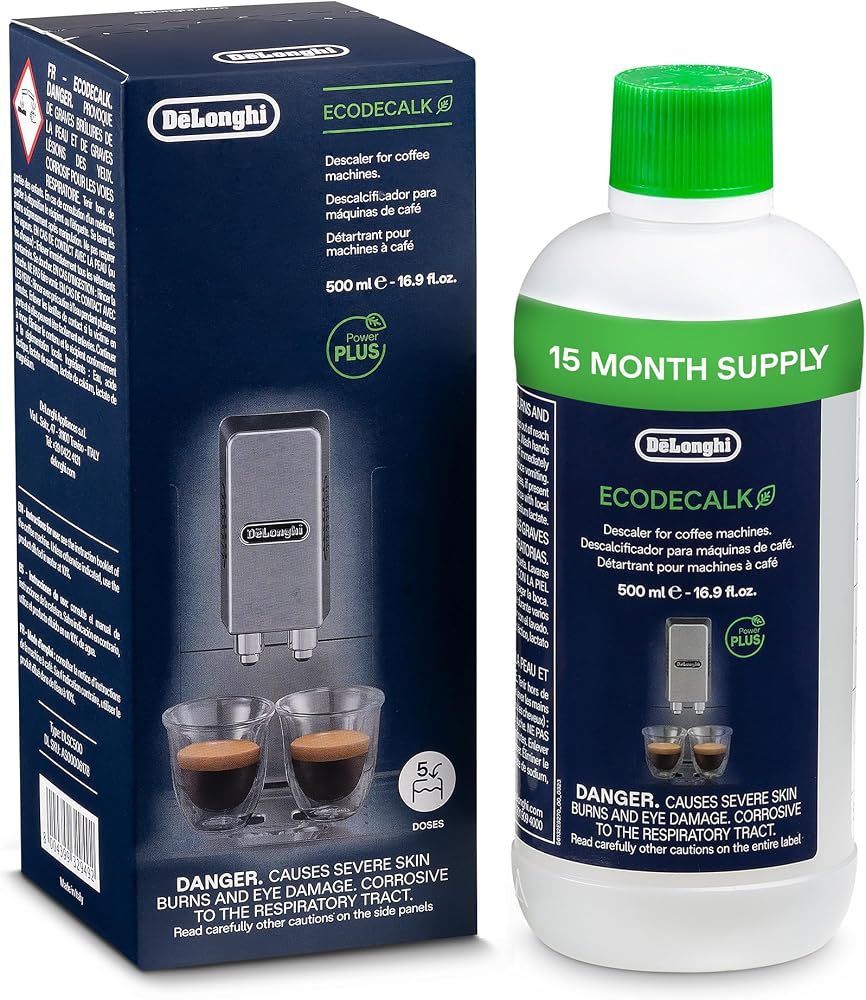
★ 4.7/5 from 166,000+ verified Amazon reviews. EcoDecalk is the descaler most coffee machines meet first, and it earns that ubiquity: it is a liquid descaler marketed as universal and eco-friendly, it works across espresso machines, coffee makers and kettles, and at $11.99 it is by far the cheapest per-treatment option here. It is De'Longhi's own product, but it is explicitly sold as suitable for other brands too. The enormous verified-owner base makes it the low-risk default: if you have no reason to pick something else, pick this.
- Pros
- Cheapest per treatment ($11.99)
- Universal – works across espresso machines and coffee makers
- Huge verified-owner base (166,000+) at 4.7★
- Eco-friendly formula
- Cons
- Not brand-specific – some machines prefer their own product
- Liquid dose must be measured
- Check the manual if your machine has a strict requirement
Durgol Swiss Espresso — Descaler & Decalcifier for All Espresso Brands
Best for Super-Automatics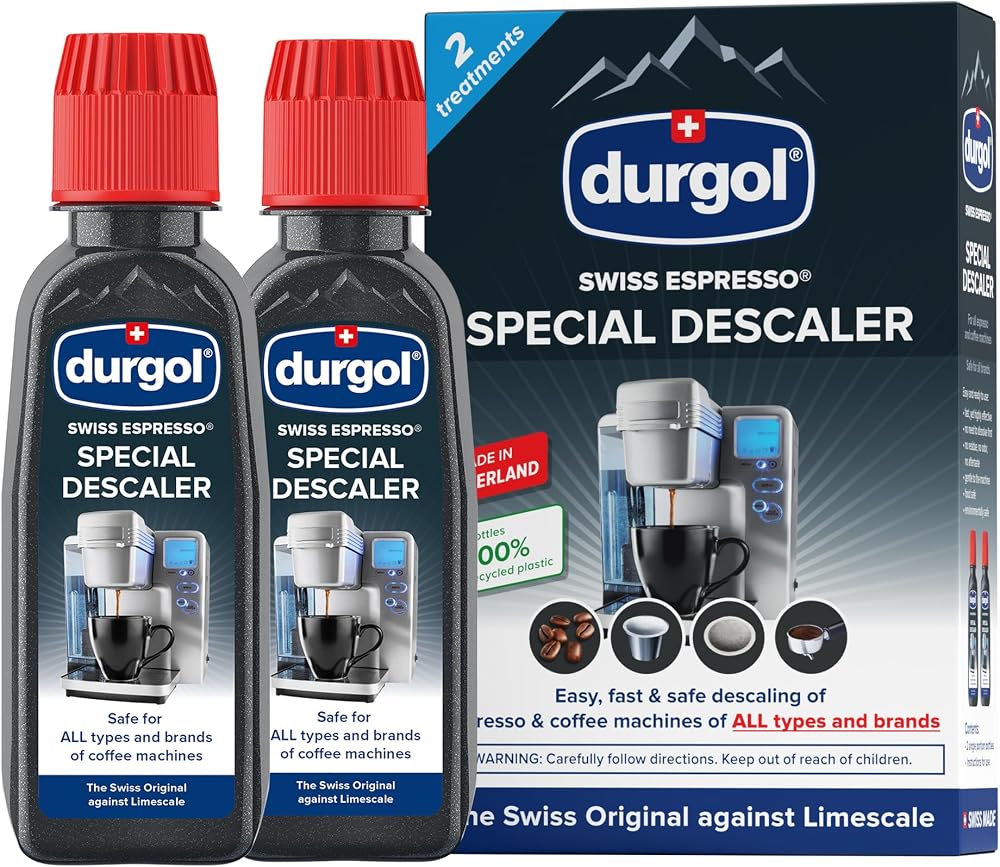
★ 4.7/5 from 3,655 verified Amazon reviews. Durgol Swiss Espresso is a single-bottle liquid descaler sold specifically for espresso machines and super-automatics, and it is a favourite in the super-automatic world (Jura, De'Longhi, Philips/Saeco, Melitta). It is marketed for use across all espresso brands, dosing is simple, and buyers rate it highly for getting machine descale programmes through cleanly. At $13.95 it is barely above the cheapest option and slightly more convenient to dose.
- Pros
- Made for espresso machines and super-automatics
- 4.7★ from 3,655 reviews
- Simple single-bottle dosing
- Swiss-made
- Cons
- Slightly dearer than EcoDecalk
- Uses per bottle limited – check the pack
- Still not a substitute for a thorough rinse
Breville BES007 Espresso Machine Descaler (4-Pack)
Best for Breville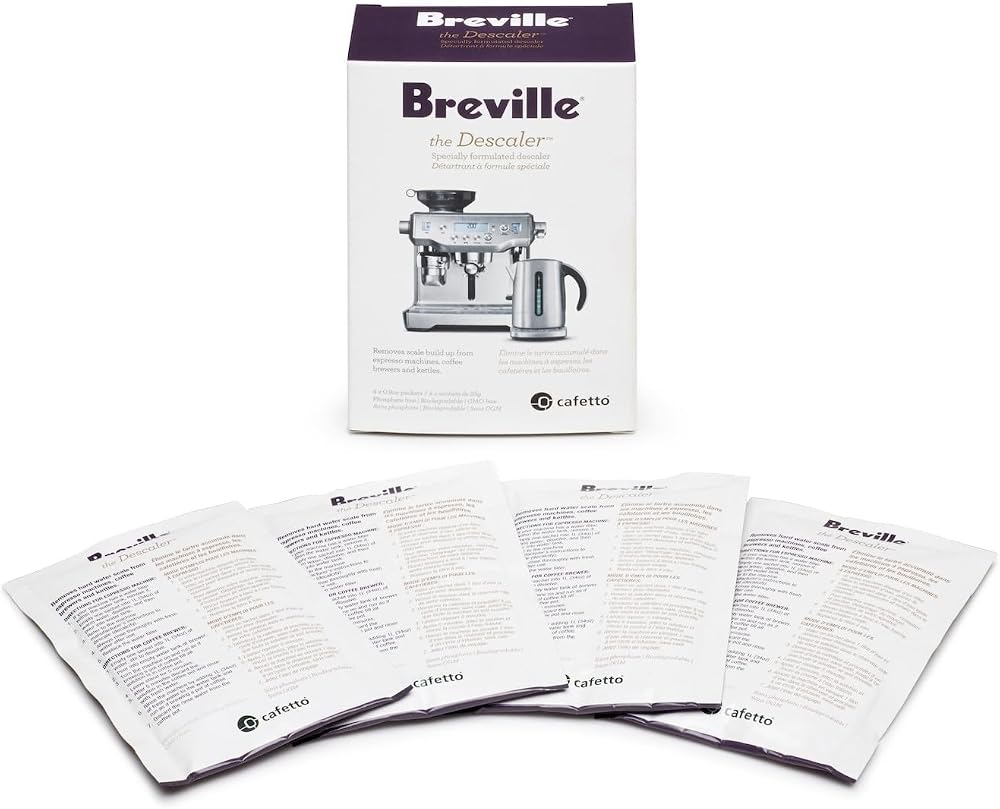
★ 4.8/5 from 2,611 verified Amazon reviews. Breville machines have their own descaling mode and Breville recommends its own descaler; the BES007 is that product, supplied as a four-pack. It is the friction-free choice for Breville owners – no guessing whether a universal liquid is compatible with the machine's programme – and at $12.99 for four treatments it is good value. If you own a Breville, this plus a fresh set of ClaroSwiss filters (see the filter guide) is the complete maintenance kit.
- Pros
- Breville's own descaler – matches the machine's programme
- 4.8★ from 2,611 reviews
- 4 treatments for $12.99
- No compatibility guesswork
- Cons
- Only for Breville machines
- Four-pack is a fixed quantity
- Brand loyalty premium vs generic liquids
Urnex Dezcal Coffee & Espresso Machine Descaler Powder
Best Powder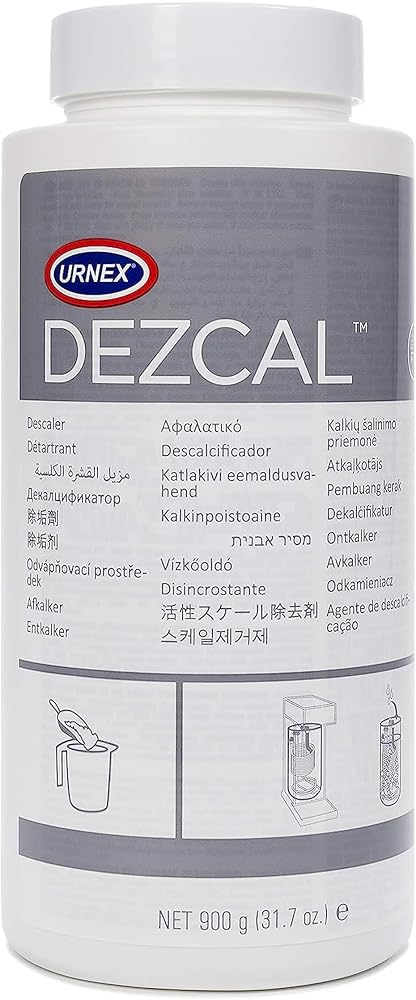
★ 4.6/5 from 5,017 verified Amazon reviews. Urnex is the professional coffee-equipment brand (its Cafiza cleaner is a café standard), and Dezcal is its descaler. This is the powder form: you measure it out, so one tub covers many descales and works out cheaper per treatment than liquid bottles over time. It is a strong choice if you maintain more than one machine or descale often, and the brand pedigree is real. The trade-off versus liquid is that you mix it yourself rather than pouring a pre-measured bottle.
- Pros
- Pro-brand formulation (Urnex/Cafiza stable)
- Tub covers many descales – good long-term value
- 4.6★ from 5,017 reviews
- Powder dissolves to your chosen dose
- Cons
- Higher up-front price ($29.98)
- You must measure and mix
- Overkill if you descale rarely
Gaggia Decalcifier Descaler Solution (Pack of 2)
Best for Gaggia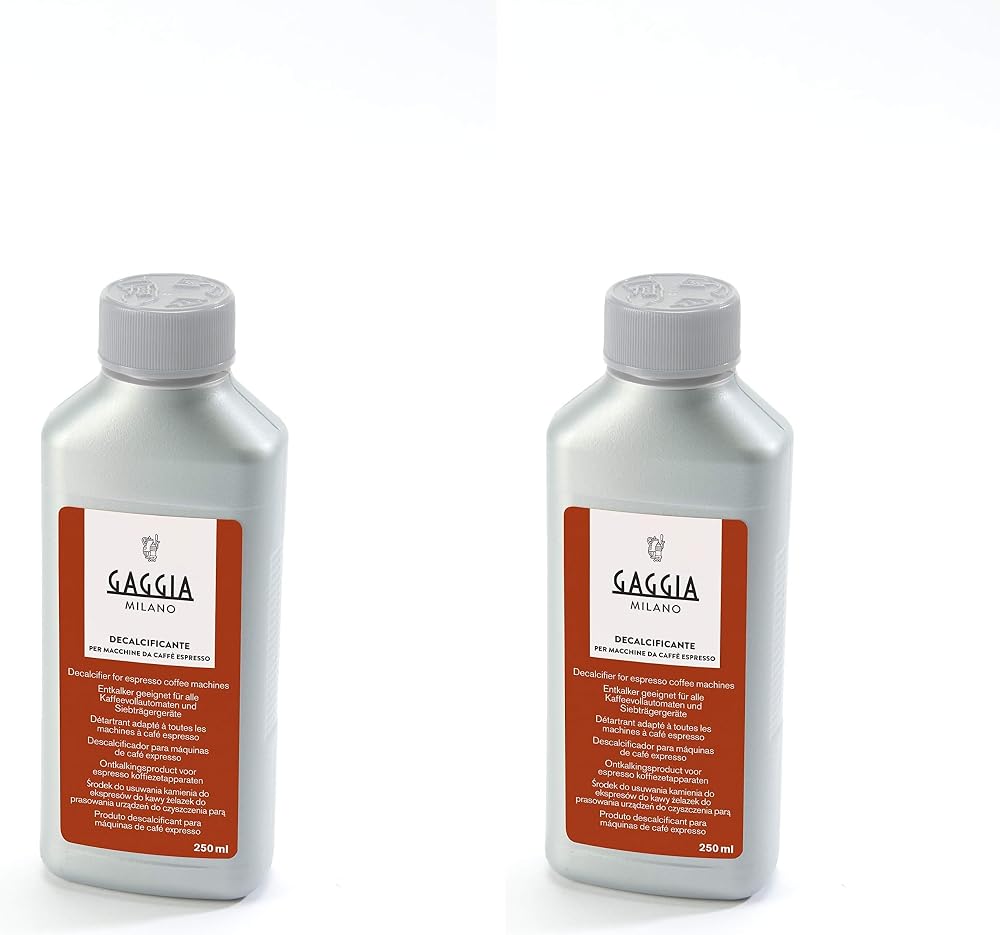
★ 4.7/5 from 4,235 verified Amazon reviews. Gaggia's own decalcifier solution, sold as a two-pack, is the specified choice for the Gaggia Classic, Classic Evo Pro and Gaggia super-automatics. Owners rate it highly and it takes the guesswork out of the dose for Gaggia's boilers and descaling routine. Pair it with a Brita Intenza+ filter (in the filter guide) and you have the standard Gaggia maintenance pairing.
- Pros
- Gaggia's own solution – correct for its boilers
- 4.7★ from 4,235 reviews
- Two treatments per pack
- Simple dosing
- Cons
- Gaggia-specific
- More per treatment than a universal liquid
- Two-pack is a fixed quantity
Melitta Liquid Descaler for Automatic Coffee Machines
Best for Super-Automatics & Capsules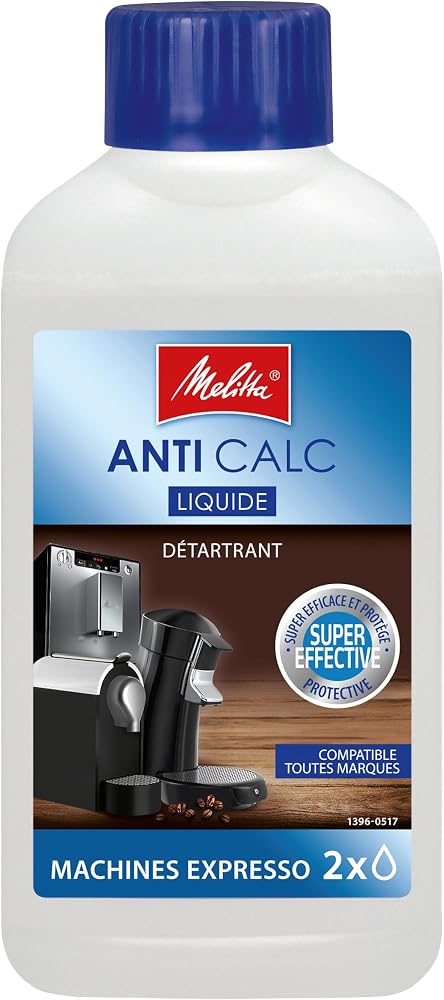
★ 4.6/5 from 4,533 verified Amazon reviews. Melitta's liquid descaler is formulated for automatic coffee machines and capsule systems, and it is a solid pick if you run a Melitta machine (or another super-automatic that tolerates a general descaler) and want a brand-formulated liquid rather than a powder. It sits at the higher end of the price range here, so it makes most sense when brand-matching matters to you or as part of a Melitta care routine. As with every descaler, the rinse is what protects the taste.
- Pros
- Formulated for automatic machines and capsules
- 4.6★ from 4,533 reviews
- Brand formula, simple liquid dosing
- Good fit for Melitta owners
- Cons
- Most expensive option here ($31.86)
- Best value only if it matches your machine
- Rinse still essential
Descaler vs Cleaner: You Need Both
New owners often conflate the two, and the confusion causes machines to be half-maintained.
- Descaler removes limescale – the mineral deposits in the boiler and water paths. That is this guide, and it runs every 2–3 months.
- Cleaner (Cafiza-style powder or tablets) removes coffee oils and residue from the group, portafilter and backflush circuit. That runs weekly to monthly and is covered in how to clean an espresso machine.
Using the wrong one for the job either wastes money or leaves a problem behind. Descale on schedule and clean on schedule, and your machine will outlast the warranty by years.
Prevention: Descale Less by Filtering Your Water
The cheapest descale is the one you rarely need. Scale forms because of the minerals in your water, so the single best long-term move is to feed the machine better water: a matching in-tank or inline filter, or filtered tap water (see our TappWater review) if you want it handled at the source. If your water is very hard, an inline BWT filter or a softening setup can push the descale interval from monthly to something far more relaxed. And if contamination rather than scale is your worry, start with PFAS in drinking water.
FAQ
How often should I descale my espresso machine?
For most home machines, every two to three months is a sensible baseline, or whenever the machine's descaling indicator lights up. If your water is hard (roughly above 5 grains per gallon), descale closer to every one to two months, and if you use soft or filtered water you can stretch the interval. Heavy daily use shortens it further. The single best way to know is to run your machine's built-in descale reminder, or count the litres and check your water hardness.
Can I use vinegar to descale my espresso machine?
Many manufacturers advise against it, and so do we. Vinegar (acetic acid) can attack rubber seals, gaskets and some metal parts, and its taste is genuinely difficult to rinse completely out of a machine, so it can taint shots for days. Several brands explicitly say using vinegar may void the warranty. Use a purpose-made espresso descaler instead – they are inexpensive, designed for the materials, and rinse clean.
What is the difference between a descaler and a cleaner?
They do different jobs and you need both. A descaler removes limescale (mineral deposits) from the boiler, thermoblock and water paths – that is the job covered here. A cleaner (often a Cafiza-style powder or tablets) removes coffee oils and residue from the group, portafilter and backflush circuit. Descale every few months; clean the coffee side weekly to monthly. One does not replace the other.
Do I need to descale if I use filtered water?
You can go much longer between descales, but you are rarely completely free of it. A good filter removes much of the calcium that forms scale, so the interval stretches – which is the main reason to filter in the first place. But filters do not remove everything, and any water with minerals can eventually deposit scale. Keep descaling on the schedule; just expect to need it less often, and let the machine's indicator guide you.
How do I know if my espresso machine needs descaling?
The classic signs are shots that run noticeably slower than before, a machine that struggles to reach or hold temperature, a flashing or steady descale indicator, reduced steam power, and a bitter or metallic edge to the coffee. Several of these overlap with other problems, but if the machine is due on schedule and shots are slowing, scale is the most likely cause. Descale before chasing other fixes.
Is descaling safe, or can it damage my machine?
Done with a proper descaler and rinsed thoroughly, descaling is safe and expected maintenance. The risks come from using the wrong substance (such as vinegar), using the wrong concentration, or failing to rinse fully – leftover descaler can affect taste and, over time, parts. Follow your machine's own descaling procedure and the descaler's dose, and always finish with two or three tanks of clean water until no residue or odour remains.
Bottom Line
Descale every 2–3 months, sooner with hard water, using your machine's own programme and a proper descaler. Our overall pick is De'Longhi EcoDecalk – the cheapest per treatment, universal and backed by a huge verified-owner base. Match the brand if you prefer: Durgol Swiss Espresso for super-automatics, Breville BES007 for Breville, Gaggia Decalcifier for Gaggia, Urnex Dezcal if you want a multi-use powder, and Melitta for its own machines. Whatever you choose: never vinegar, and rinse until the water is tasteless. Then cut the descales you need in the first place with the right water filter and good espresso water.
