FTC Disclosure: LimeCrema is reader-supported. When you buy through links on our site, we may earn an affiliate commission at no extra cost to you. Learn more.
Prices shown are pulled from the Amazon API and were last checked on 01.11.2026. Amazon prices and availability change constantly – the price on Amazon at the time of purchase is the one that applies.
PFAS filters are sold on a promise that is easy to make and hard to check. “Removes forever chemicals” appears on pitchers, under-sink systems and countertop boxes – but the only thing that separates a real filter from a marketing claim is a certification number, and most shoppers never look one up.
This guide does the boring part for you. Five filters that either carry a PFAS-relevant certification or make a specific, checkable manufacturer claim, compared on technology, replacement cost and what thousands of owners say. Prices were verified on Amazon.com on 27 October 2026.
One honest limit up front: we have not measured PFAS in any of these filters' output. What we can do is tell you which certification covers PFOA and PFOS, which technologies are capable of removing them, and where a manufacturer's claim stops and an independent test begins.
| Filter | Best for | Price | Link |
|---|---|---|---|
| Aquasana AQ-5300.56 | Best overall under-sink | $125.99 | View on Amazon |
| ZeroWater 12-Cup Pitcher | Best budget, huge review base | $39.99 | View on Amazon |
| CuZn UC-150 Under-Sink | Best value under-sink | $99.99 | View on Amazon |
| LifeStraw Home 18-Cup Dispenser | Best countertop dispenser | $64.95 | View on Amazon |
| DREO Countertop RO | Best reverse osmosis | $79.99 | View on Amazon |
The certification that actually matters
Four NSF/ANSI standards come up constantly, and only two mean anything for PFAS:
- NSF/ANSI 53 – health effects, including cyst, lead and PFOA/PFOS reduction. This is the one to look for on a carbon-based filter.
- NSF/ANSI 58 – reverse osmosis systems. RO removes PFAS very effectively as a function of the membrane, and 58 is the standard that certifies the system.
- NSF/ANSI 42 – aesthetic effects: chlorine taste, odour, sediment. Nothing to do with PFAS.
- NSF/ANSI 372 – lead content of the materials. Also nothing to do with PFAS.
So a filter advertised as “NSF/ANSI 42 & 372 certified” is telling you it improves taste and contains no lead – not that it removes forever chemicals. That distinction eliminates most of the category. When a listing claims a specific PFAS reduction, the claim is worth checking against the manufacturer's certification listing before you buy; certification covers specific models, not brands.
Which technologies can remove PFAS
Reverse osmosis is the most reliable: the membrane rejects the molecules along with most dissolved solids, which is also why RO water tastes flat and often needs remineralising for coffee. Activated carbon block can remove PFOA and PFOS when it is dense enough and certified to NSF 53 – cheap carbon pitchers generally are not. Ion-exchange media, as used by ZeroWater, reduces dissolved solids aggressively and is the basis of its PFAS claim. Granular carbon in a basic pitcher is the weakest option for PFAS specifically.
Pitcher, under-sink or reverse osmosis?
A pitcher costs $30–60 and suits one or two people filtering drinking water. An under-sink system costs $100–250, is plumbed in once and gives unlimited flow at the tap – the right answer if you cook and brew with the water too. Countertop RO sits between: no plumbing, but wastewater, a tank to empty and slower output. If coffee is the main use, remember RO water needs minerals added back – see our espresso water guide.
The 5 best water filters for PFAS
Aquasana AQ-5300.56 Under-Sink Water Filter, 3-Stage
Best Overall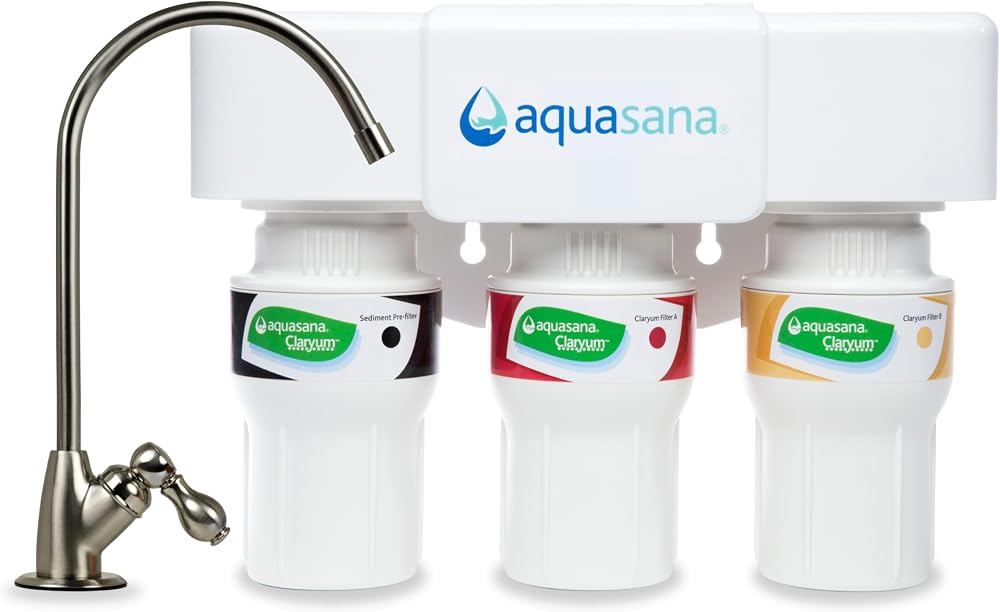
- Price
- $125.99
★ 4.2/5 from 2,965 verified Amazon reviews at $125.99. The AQ-5300 is the system we would install in our own kitchen: a three-stage under-sink unit whose listing states it reduces up to 99% of 78 contaminants including PFAS – specifically PFOA and PFOS – plus lead, chlorine and pesticides, while leaving minerals in the water. Flow is about half a gallon a minute, which is enough for a kettle and a coffee machine at the same time. Filters last six months or 600 gallons and cost less than ten cents a gallon according to the manufacturer. Owners rate it well for taste and installation; complaints are the plastic faucet and replacement cost.
View on Amazon →ZeroWater 12-Cup Pitcher with TDS Meter
Best Budget- Price
- $39.99
★ 4.2/5 from 49,197 verified Amazon reviews at $31.99. The largest review base in this category by an order of magnitude, and the cheapest way into PFAS filtration: it names PFOA/PFAS in the title, uses a five-stage ion-exchange filter, and ships with a TDS meter so you can see when the media is spent. That meter matters: these filters exhaust visibly and the taste falls off a cliff when they do. Expect more frequent replacements than an under-sink system, which narrows the price gap over a year – but for one person filtering drinking water it is still the smartest $32 here.
View on Amazon →CuZn UC-150 Under-Sink Water Filter
Best Value Under-Sink- Price
- $99.99
★ 4.6/5 from 6,915 verified Amazon reviews at $99.99. The best-reviewed under-sink filter on this list, and the cheapest to own: CuZn rates the cartridge for 20,000 gallons or two years, against six months for most competitors. It combines micro-sift membranes, KDF-55 and coconut-shell carbon, and the listing states it reduces PFAS and PFOS. Read the certification carefully, though: CuZn claims NSF/ANSI 42 and 372, which cover taste/chlorine and lead-free materials – not 53, the standard that certifies PFOA/PFOS reduction. That does not make the PFAS claim false; it means the claim is the manufacturer's, not a certification. At this price and lifespan, it is still the value pick.
View on Amazon →LifeStraw Home 18-Cup Water Filter Dispenser
Best Countertop Dispenser- Price
- $64.95
★ 4.2/5 from 1,598 verified Amazon reviews at $51.96. The only filter here that also claims to remove bacteria, parasites and microplastics – a membrane microfilter plus activated carbon and ion exchange. LifeStraw states the membrane lasts 264 gallons (about a year) and the carbon filter 40 gallons (about two months), which is a usefully specific pair of numbers. The 18-cup format suits a family or an office and needs no plumbing. As with every claim in this category, the PFAS reduction is the manufacturer's – verify the certification, not the badge.
View on Amazon →DREO Countertop Reverse Osmosis Water Filter
Best Reverse Osmosis- Price
- $79.99
★ 4.4/5 from 1,105 verified Amazon reviews at $79.99. Reverse osmosis is the technology with the strongest removal case for PFAS, and this is the cheapest credible way to get it onto a counter: no plumbing, a three-litre tank and a plug. It removes essentially all dissolved solids, which is excellent for PFAS and terrible for coffee – you will want to add minerals back, as we explain in the TDS and hardness guide. It also produces wastewater and runs slowly compared with a tap. If your priority is maximum removal rather than speed, this is the pick.
View on Amazon →What about whole-house systems and gravity filters?
Whole-house carbon tanks can reduce PFAS at every tap, but they cost $1,000+ installed and their certification is often for chlorine and taste. Gravity-fed stainless filters have a devoted following, but the widely sold models are not certified to NSF/ANSI 53 or 58 for PFOA/PFOS. Neither is a bad product; neither is a verifiable PFAS answer.
Cost per gallon, honestly
The purchase price is the least interesting number. A $32 pitcher with a $15 filter every six weeks costs more per gallon than a $126 under-sink system with a $60 filter every six months. Before buying, price the replacement cartridge and divide by its rated gallons – then check whether the rating is realistic for your household. A family of four filtering all drinking and cooking water will exhaust a pitcher in weeks and an under-sink cartridge in months.
FAQ
Which certification removes PFAS from drinking water?
NSF/ANSI 53 covers PFOA and PFOS reduction for carbon-based filters, and NSF/ANSI 58 covers reverse osmosis systems. NSF/ANSI 42 (taste, chlorine) and 372 (lead-free materials) say nothing about PFAS, even though they appear on many filter boxes.
Does a Brita pitcher remove PFAS?
Standard Brita pitchers are certified for taste, chlorine and some metals, not for PFOA/PFOS reduction. Some newer models claim additional reduction, so check the specific model's certification rather than the brand. If PFAS is the goal, choose a filter whose listing names PFOA/PFOS and states its certification.
Is reverse osmosis better than carbon for PFAS?
For PFAS specifically, yes – the membrane rejects the molecules reliably, which is why NSF/ANSI 58 exists. The trade-off is that RO also strips the minerals that make coffee taste good, costs more per litre and produces wastewater, so many coffee drinkers remineralise the water afterwards.
How often do PFAS filters need replacing?
Follow the rated gallonage, not the calendar: the ratings here run from 40 gallons for a LifeStraw carbon stage to 20,000 gallons for a CuZn cartridge. Replace early if flow drops or taste changes – exhausted carbon can release what it captured.
Do I need a filter if my water utility says it meets PFAS limits?
Not necessarily. The EPA's 2024 limits for PFOA and PFOS are 4 parts per trillion, and utilities are working toward compliance. If your utility reports detections below the limit, a filter is a precaution rather than a necessity – but if you are on a private well, or your utility has reported exceedances, filtration is the sensible move.
Will a PFAS filter help my espresso machine?
It helps the water, but it is not a descaling solution. RO strips hardness entirely, which stops scale but needs remineralising; carbon leaves hardness largely intact. Pair the filter with the right water recipe and descale on schedule regardless.
Bottom Line
Buy the certification, not the badge. For most kitchens the Aquasana AQ-5300.56 is the right balance of price, flow and a specific PFOA/PFOS claim; the ZeroWater 12-Cup is the cheapest credible entry with the largest owner base; the CuZn UC-150 wins on cost of ownership if you accept that its certification covers taste and materials rather than PFAS; the LifeStraw Home is the best dispenser and the only one here claiming microplastics too; and the DREO countertop RO is the maximum-removal option. Whichever you pick, verify the model on the manufacturer's certification listing, and read PFAS in drinking water for the health background.
