FTC Disclosure: LimeCrema is reader-supported. When you buy through links on our site, we may earn an affiliate commission at no extra cost to you. Learn more.
If you are trying to get plastic out of your coffee, the water path is the part that matters. Hot water is the best solvent in your kitchen, and every plastic reservoir, brew basket or carafe it touches is an opportunity for microplastics and chemical additives to migrate into the cup. The fix is simple: brew with glass, stainless steel or ceramic instead. We compared the seven most popular plastic-free and PFAS-free coffee makers on the US market – materials in the water path, brew method, capacity, build quality and owner satisfaction across tens of thousands of verified reviews. There is no plastic-free espresso machine on this list; if you want espresso, a plastic-free manual lever machine (see our manual espresso guide) is your closest option.
| Product | Key Benefit | Price | Link |
|---|---|---|---|
| SimplyGoodCoffee THE BREWER | Best Overall | $479.99 | Check Price |
| Zojirushi ZUTTO EC-DAC50SZ | Best PFAS-Free | $89.95 | Check Price |
| aarke Drip Coffee Maker | Best Premium Design | $320.00 | Check Price |
| Fellow Stagg [XF] Pour-Over Set | Best Pour-Over Set | $99.95 | Check Price |
| Chemex 8-Cup Classic | Highest Rated | $48.95 | Check Price |
| Bodum Pour Over 34oz | Best Budget | $19.99 | Check Price |
| Stainless Steel French Press 34 oz | Best French Press | $42.95 | Check Price |
The 7 Best Plastic-Free Coffee Makers
SimplyGoodCoffee THE BREWER — Plastic-Free 8-Cup Drip Pour-Over
Best Overall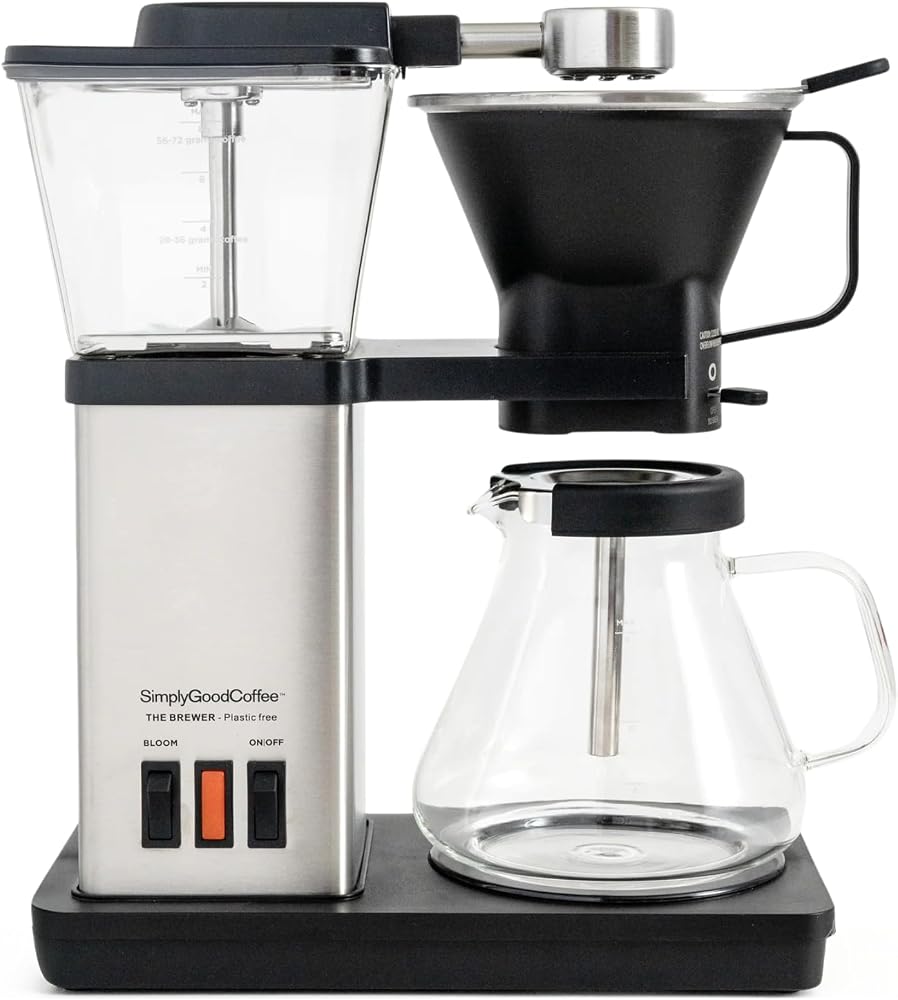
- Price
- $479.99
★ 4.1/5 from 183 verified Amazon reviews. THE BREWER is the rare automatic drip machine built without plastic in the water path – the body is stainless steel and the brew is a controlled pour-over, so hot water never sits against a plastic reservoir or basket. It is designed to the Specialty Coffee Association's Gold Cup Standard, meaning it is built to hold brew temperature and ratio in the window that makes good coffee. At $479.99 it is a genuine investment, and the owner base is still small at 183 reviews, but for a plastic-free automatic brewer there is almost nothing else like it.
- Pros
- No plastic in the water path
- Automatic pour-over, 8-cup capacity
- Built to Gold Cup Standard
- Stainless steel build
- Cons
- High price at $479.99
- Small review base (183)
- Rated 4.1★ – solid, not the highest here
Zojirushi EC-DAC50SZ ZUTTO Coffee Maker 5 Cups
Best PFAS-Free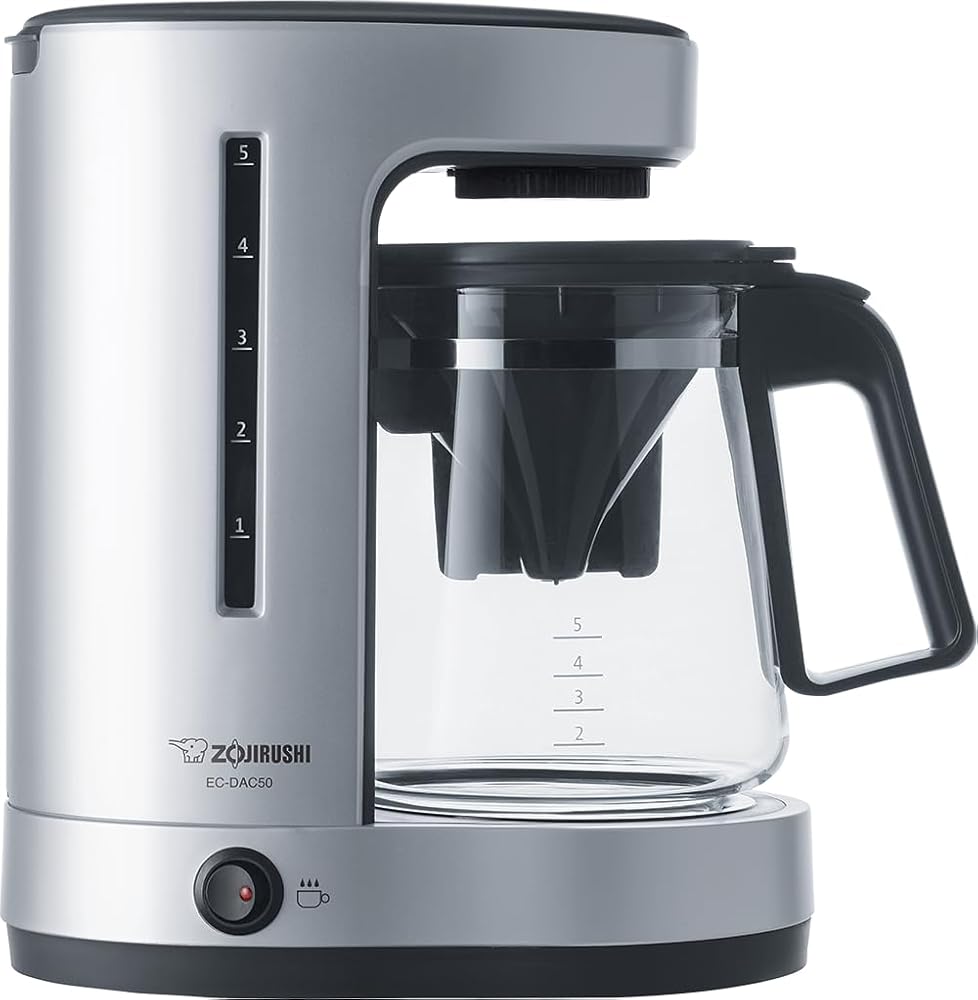
- Price
- $89.95
★ 4.2/5 from 4,100 verified Amazon reviews. The ZUTTO is the PFAS-free automatic that most people should look at first. Zojirushi builds it around a vacuum-insulated stainless carafe, so there is no hotplate and no plastic carafe in contact with your coffee, and it is explicitly marketed as PFAS-free. The 5-cup size suits one to three drinkers, it is compact, and 4,100 owners rate it 4.2★ for everyday reliability. If you want a trusted automatic machine made without PFAS, this is the value pick.
- Pros
- Marketed PFAS-free
- Vacuum-insulated steel carafe, no hotplate
- 4,100+ reviews at 4.2★
- Trusted Zojirushi build quality
- Cons
- Not advertised as 100% plastic-free
- Only 5 cups
- No programable timer
aarke Drip Coffee Maker with 42oz Glass Carafe
Best Premium Design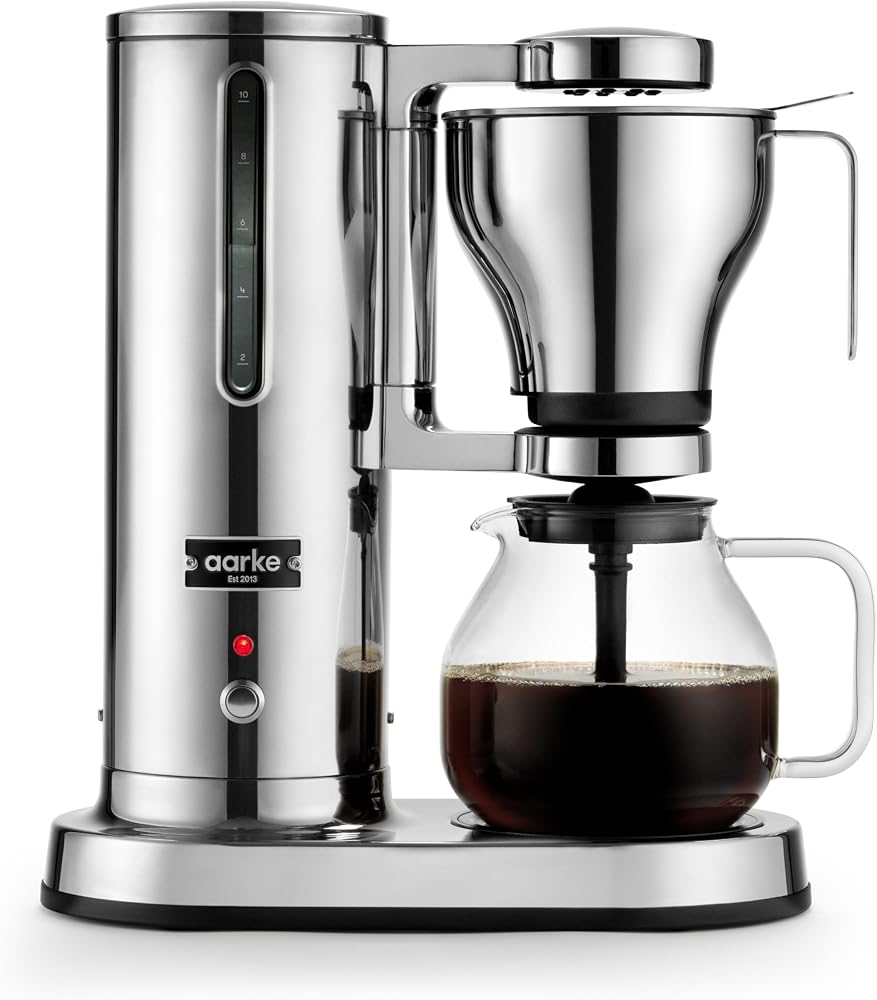
- Price
- $320.00
★ 3.6/5 from 101 verified Amazon reviews. The aarke Drip is the design statement of the group: a stainless steel body paired with a 42-ounce glass carafe, made by the Swedish company best known for its carbonators. It brews into glass rather than plastic, sits beautifully on a counter and uses a paper filter. The trade-off is honest and worth stating plainly – at 3.6★ from just 101 reviews, it is the lowest-rated machine on this list, so buy it for the materials and the design, not for a long track record.
- Pros
- Stainless steel body, glass carafe
- Large 42 oz capacity
- Clean Scandinavian design
- Paper-filter brewing
- Cons
- Lowest rating here (3.6★)
- Only 101 reviews
- Expensive at $320.00
Fellow Stagg [XF] Plastic-Free Pour-Over Coffee Maker Set
Best Pour-Over Set![Fellow Stagg [XF] Plastic-Free Pour-Over Coffee Maker Set](/images/produkte/pf-fellow-stagg-xf.jpg)
- Price
- $99.95
★ 4.5/5 from 496 verified Amazon reviews. The Fellow Stagg [XF] is the nicest way to start a plastic-free pour-over habit. It is a complete set – dripper and carafe – marketed explicitly as plastic-free, designed for one to two servings, and it looks the part in Fellow's signature matte style. Owners rate it 4.5★ across 496 reviews, praising the build and the consistency of the brew. If you are ready to move past drip machines and want one well-made object, this is the pour-over pick.
- Pros
- Marketed plastic-free
- 4.5★ from 496 reviews
- Complete dripper + carafe set
- Fellow build quality and design
- Cons
- Only 1–2 servings per brew
- Manual – you control the pour
- Premium price for a dripper
Chemex Pour-Over Glass Coffeemaker — Classic Series, 8-Cup
Highest Rated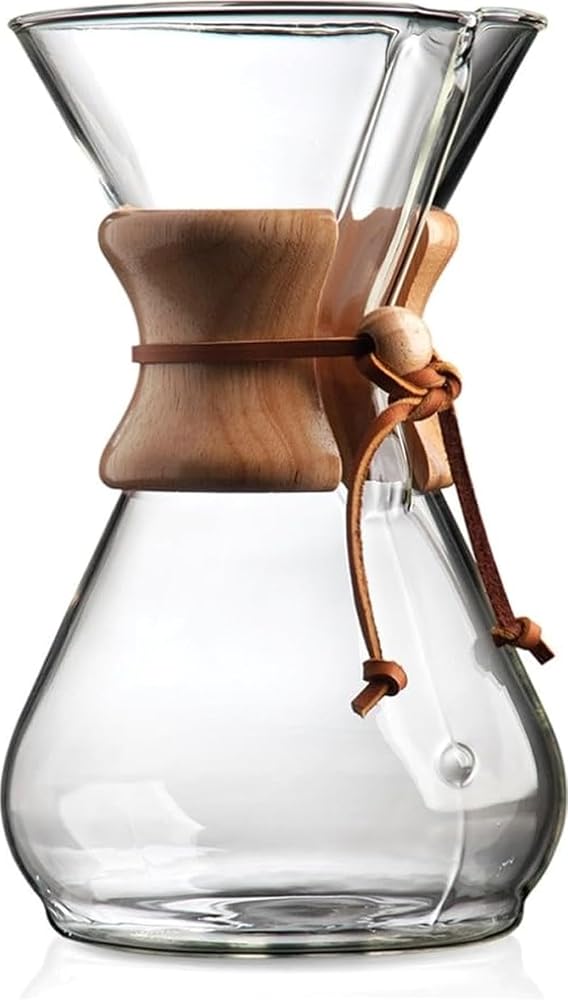
- Price
- $48.95
★ 4.8/5 from 8,700 verified Amazon reviews. The Chemex is the most decorated brewer on this list – 4.8★ from 8,700 owners – and it is about as plastic-free as brewing gets: one piece of borosilicate glass, a wooden collar and a paper filter. Nothing hot touches plastic at any point. It brews a clean, sediment-free 8-cup batch, and the design has been essentially unchanged for decades, which is its own quality statement. The only real cost is the ritual, and the filters.
- Pros
- Highest rating here (4.8★, 8,700 reviews)
- Borosilicate glass – no plastic in the path
- Clean, sediment-free cup
- Classic, time-tested design
- Cons
- Requires paper filters
- Manual pour-over technique
- Glass carafe needs careful handling
Bodum 34oz Pour Over Coffee Maker
Best Budget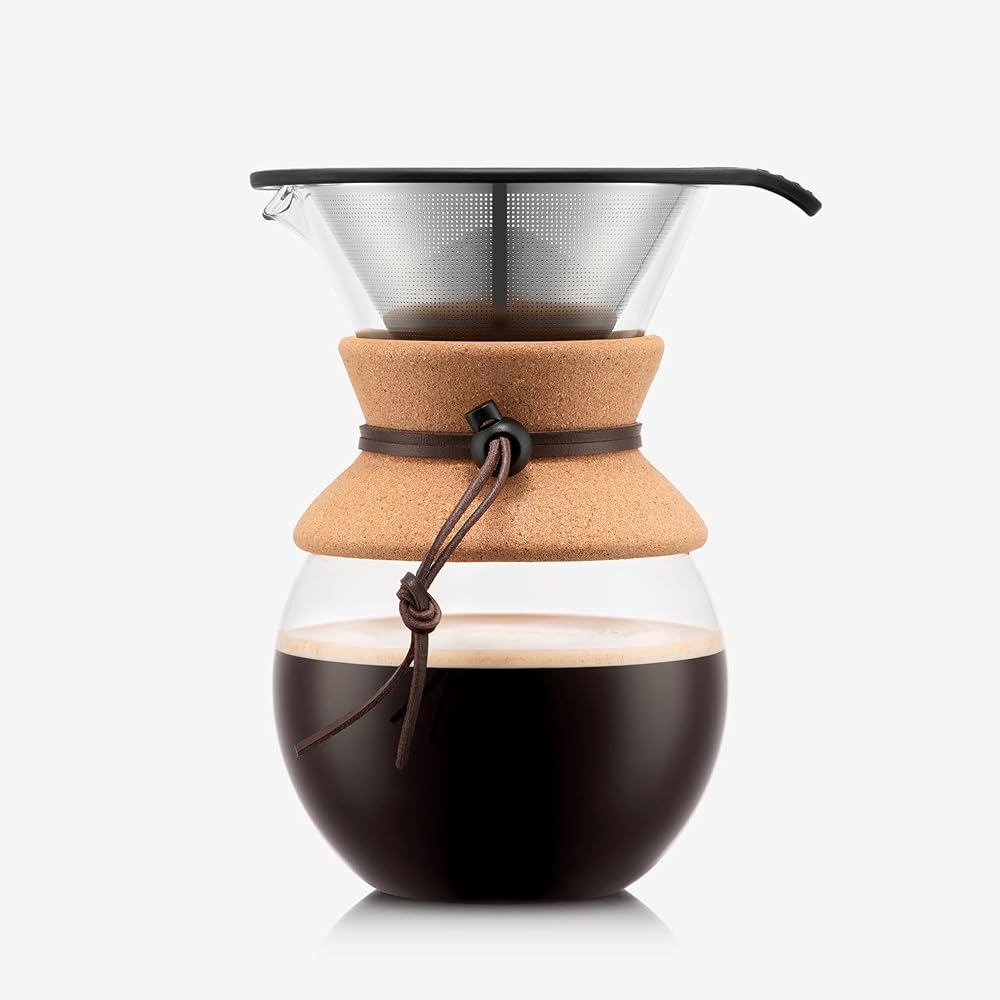
- Price
- $19.99
★ 4.5/5 from 11,800 verified Amazon reviews. The Bodum Pour Over is the cheapest way on this list to brew without plastic – and one of the most reviewed at 11,800 ratings and 4.5★. Hot water meets borosilicate glass and a reusable stainless steel filter, so there is no plastic in the water path and no paper filters to buy either. The cork grip looks good and stays cool. It is simple, it is $19.99, and it does the job.
- Pros
- Only $19.99
- 11,800+ reviews at 4.5★
- Glass body + reusable steel filter
- No paper filters needed
- Cons
- No paper filter means more oils and sediment
- Manual brewing
- Cork collar can wear over time
Non-Toxic Stainless Steel French Press, 34 oz
Best French Press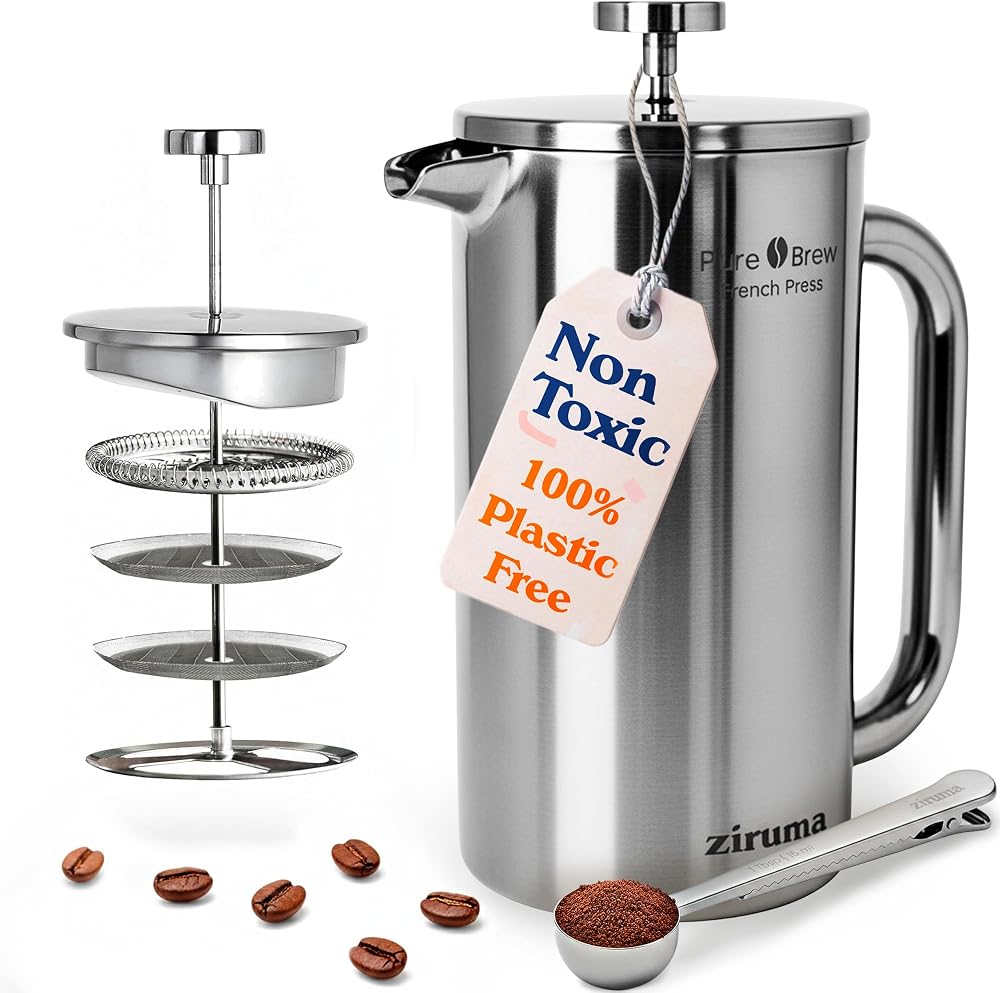
- Price
- $42.95
★ 4.7/5 from 951 verified Amazon reviews. If you like full-bodied, immersion-brewed coffee, this is the plastic-free French press to get. It is stainless steel inside and out and marketed as containing no plastic or heavy metals, so the hot water and grounds stay in contact with metal only. It holds 34 ounces – about three cups – and 951 owners rate it 4.7★. For a simple, robust, no-plastic brewer that takes any grind of coffee, it is hard to beat at $42.95. (Prefer a classic glass press? See our best French press guide.)
- Pros
- Stainless steel inside and out
- Marketed as no plastic, no heavy metals
- 4.7★ from 951 reviews
- 34 oz – about three cups
- Cons
- You cannot watch the brew through steel
- Metal presses lose heat faster than double-walled glass
- Needs a coarse grind
How to Choose a Plastic-Free Coffee Maker
Focus on the water path, not the housing
Almost every appliance has some plastic on the outside – a handle, a base, a display. What matters for your coffee is the water path: the reservoir, the brew basket, the carafe and any tubing. Brew with glass, stainless steel or ceramic in those places and you have removed the contact points that matter most. An outer plastic shell that never touches hot water is far less of a concern.
Automatic vs manual
Plastic-free automatic brewers exist but are rare and pricey – THE BREWER at $479.99 is the standout. Manual brewing (pour-over, French press, Moka pot) is where plastic-free gets cheap and easy: the Bodum Pour Over is $19.99, the Chemex is $48.95. If convenience is the priority, budget for an automatic; if cost and simplicity are, go manual.
PFAS-free vs plastic-free
These are not the same thing. "PFAS-free" means the maker avoids per- and polyfluoroalkyl substances – the non-stick "forever chemicals" often used in coatings. "Plastic-free" is broader and covers all plastic, including the clear carafes and reservoirs. The Zojirushi ZUTTO is PFAS-free; THE BREWER and the manual brewers here are plastic-free. Read the spec sheet for the water path, not just the marketing headline.
Match the brewer to your habit
One or two cups a day: a 5-cup ZUTTO or a single-serve pour-over set. Three to four: a 34 oz French press or the Bodum. Batch brewing for a household: the 8-cup Chemex or THE BREWER. Buying for the size you actually drink beats buying for the biggest number on the box – and it is the cheapest way to stay plastic-free.
FAQ
Do plastic coffee makers leach microplastics into coffee?
Heat and time are the two factors that matter most. When hot water sits against plastic parts – kettles, reservoirs, brew baskets or carafes – small amounts of microplastics and chemical additives have the opportunity to migrate into the brew. The concern is greatest with hot water in direct contact with plastic. A coffee maker built from glass, stainless steel or ceramic removes that contact point almost entirely, which is why plastic-free models have become popular.
Which coffee makers are truly plastic-free?
The common plastic-free designs are manual and low-tech: pour-over drippers (glass, ceramic or stainless steel), French presses with a steel or glass body and a stainless steel plunger, Moka pots, and a small number of automatic drip brewers built with stainless steel and glass in the water path. On this list, the SimplyGoodCoffee THE BREWER is the plastic-free automatic pick, while the Zojirushi ZUTTO is PFAS-free. Always check the water path – the reservoir, brew basket and carafe – rather than relying on the outer housing.
Is a French press plastic-free?
Not always, but it can be. Many classic French presses use plastic or nylon seals, and some have a plastic lid or handle. A stainless steel French press with a metal plunger and a silicone or steel seal – like the 34 oz model on this list – keeps the hot water and coffee in contact with stainless steel and glass only, which makes it one of the simplest genuinely plastic-free ways to brew.
Is plastic-free coffee gear more expensive?
It does not have to be. Manual plastic-free brewers are often cheaper than plastic automatic machines: the Bodum pour-over starts around $20, a Chemex 8-cup is about $49, and a stainless steel French press runs roughly $43. Where you pay more is at the automatic end – a plastic-free automatic drip brewer like SimplyGoodCoffee THE BREWER is a $479.99 investment. So the premium is tied to automation and build materials, not to going plastic-free in general.
How do I clean a stainless steel or glass coffee maker?
Both materials are forgiving. Rinse glass carafes and stainless steel bodies with warm water and mild dish soap, and use a soft brush or non-scratch sponge – avoid abrasive pads that can dull stainless steel. For hard-water film, a warm water and white vinegar solution, followed by a thorough rinse, dissolves mineral buildup without harsh chemicals. Never put a glass carafe or stainless steel press through a dishwasher unless the maker states it is dishwasher-safe, and always let parts cool before cleaning.
Bottom Line
For a plastic-free automatic brewer, the SimplyGoodCoffee THE BREWER is the honest winner – no plastic in the water path and Gold Cup Standard brewing, at a real price ($479.99). Want automation for less and are happy with PFAS-free rather than fully plastic-free? The Zojirushi ZUTTO is the value pick. For manual brewing, the Chemex 8-Cup is the highest-rated plastic-free brewer on the list, the Fellow Stagg [XF] is the best set, and the Bodum Pour Over proves you can do it for under $20. Whatever you choose, keep it clean and buy the size you actually drink.
